Dominant First Half Sets Foundation for Valencia Victory
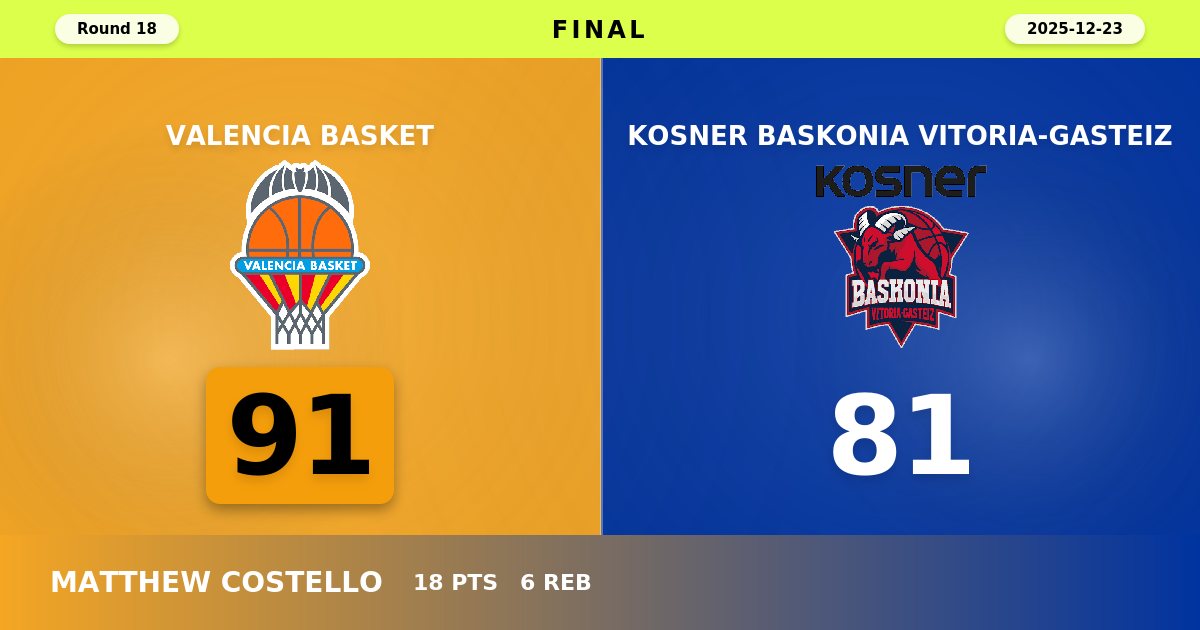
Valencia Basket delivered an impressive performance at home, defeating Kosner Baskonia Vitoria-Gasteiz 91-81 in Round 18 of EuroLeague action. Playing in front of 12,320 passionate fans, Valencia controlled the tempo from the opening tip, establishing a commanding first-half lead that would prove insurmountable for their Spanish rivals. The victory improves Valencia's recent form after a mixed stretch of results, while Baskonia continues to struggle with consistency on the road.
The home side exploded out of the gates, dominating the first quarter 27-19 and setting the tone for what would become a comprehensive victory. Valencia's defensive intensity and offensive execution were on full display as they built their advantage methodically. The second quarter saw both teams trading baskets in a higher-scoring affair, with Valencia edging the period 31-28 to take a 58-47 lead into halftime. That eleven-point cushion would prove crucial as Baskonia mounted several comeback attempts in the second half.
Jean Montero Orchestrates Valencia's Offensive Attack
Jean Montero emerged as the catalyst for Valencia's success, delivering an all-around performance that showcased his growing maturity as a playmaker. The Dominican guard finished with 16 points, 5 rebounds, and 4 assists in over 23 minutes of action, recording an efficiency rating of 19 and a team-best plus-minus of +18. His ability to create shots for himself and teammates kept Baskonia's defense constantly scrambling. Montero's perimeter shooting was particularly effective, connecting on three of seven attempts from beyond the arc while maintaining perfect accuracy from the free-throw line with three makes.
Matthew Costello provided the interior presence Valencia needed, dominating the paint with 18 points on an efficient 6-of-8 shooting performance. The Ivory Coast international was particularly dangerous from three-point range, hitting three of four attempts to stretch Baskonia's defense. Costello's six rebounds and willingness to step outside complemented his traditional post game, making him nearly impossible to defend. His efficiency rating of 22 reflected his overall impact on the contest, even as he managed just one foul in over twenty-two minutes of playing time.
Bench Production Proves Difference for Valencia
The decisive factor in Valencia's victory came from their superior bench production, with several reserves making significant contributions. Kameron Taylor was sensational off the bench, pouring in 16 points on 5-of-7 shooting while hitting both of his three-point attempts. Taylor's ability to attack the basket earned him four trips to the free-throw line, where he converted four of five attempts. His +8 plus-minus in nearly nineteen minutes demonstrated his impact on both ends of the floor, providing Valencia with the scoring punch they needed when starters rested.
Omari Moore showcased his playmaking abilities with 11 points and 5 assists, serving as an effective secondary ball-handler for Valencia's second unit. Moore's court vision and decision-making helped maintain offensive flow, while his 4-of-7 shooting from two-point range kept Baskonia's defense honest. Nathan Reuvers provided valuable minutes with 6 points on perfect 2-of-2 shooting from three-point range, spreading the floor and creating spacing problems for Baskonia's interior defense. His +13 plus-minus in just over twelve minutes highlighted his positive impact during his stint on the court.
Baskonia's Comeback Attempts Fall Short
Baskonia showed resilience in their efforts to climb back into the game, particularly through the play of Eugene Omoruyi, who led all Baskonia scorers with 17 points off the bench. The Canadian forward was highly efficient, shooting 5-of-6 from the field including 2-of-2 from three-point range, while adding 5 rebounds and drawing five fouls. His efficiency rating of 25 was the highest among all players in the game, demonstrating his effectiveness during his limited opportunities. Omoruyi's aggressive attacking style and finishing ability kept Baskonia within striking distance throughout the second half.
Timothe Luwawu-Cabarrot contributed 13 points in over twenty-three minutes, though his shooting efficiency left room for improvement at 4-of-13 from the field. The French wing struggled particularly from three-point range, making just one of seven attempts, but compensated by drawing fouls and converting all four free-throw attempts. Trent Forrest added 10 points and 3 assists, providing steady point guard play off the bench, though his -8 plus-minus reflected Baskonia's struggles when he was on the court.
Second Half Defensive Stand Secures Victory
The second half became a defensive battle, with both teams struggling to generate the same offensive rhythm displayed in the opening twenty minutes. The third quarter saw the teams deadlocked at 18 points apiece, as Valencia's defense tightened and Baskonia found it increasingly difficult to generate quality scoring opportunities. Valencia's defensive intensity forced Baskonia into difficult shots and created turnovers at critical moments, preventing any sustained comeback attempt.
The fourth quarter proved decisive as Valencia maintained their composure down the stretch. Despite scoring just 15 points in the final period, Valencia's defense held firm, limiting Baskonia to 16 points. Brancou Badio was instrumental in closing out the game, despite his modest scoring output. The Senegalese guard's 12 points came primarily from the free-throw line, where he was perfect on six attempts. His ability to draw fouls—receiving six in total—helped Valencia control the game's tempo in crucial moments and prevented Baskonia from establishing any momentum.
Statistical Dominance Reflects Valencia's Control
Valencia's victory was built on balanced scoring and superior ball movement. Eight different players scored for Valencia, with five reaching double figures, demonstrating the depth that makes them dangerous on any given night. The home side's shooting efficiency was impressive, particularly from three-point range where they capitalized on open looks created by excellent ball movement. Darius Thompson may not have scored, but his 5 assists in limited minutes exemplified Valencia's unselfish approach.
Baskonia's starting backcourt of Markus Howard and Kobi Simmons combined for just 17 points on 6-of-17 shooting, well below their usual production levels. Howard, typically one of Baskonia's most prolific scorers, managed only 9 points on 3-of-10 shooting, including a disappointing 2-of-7 from beyond the arc. Simmons added 8 points and 4 assists but committed 4 turnovers that disrupted Baskonia's offensive flow. The inability of Baskonia's primary playmakers to generate consistent offense proved costly against Valencia's organized defense.
Implications for Both Spanish Sides
This victory represents an important step forward for Valencia Basket as they navigate the competitive EuroLeague landscape. Coming off a loss to Maccabi Tel Aviv, this performance demonstrated their ability to bounce back and execute their game plan effectively at home. The balanced scoring attack and strong defensive performance provide a template for success moving forward. Valencia's ability to get contributions from throughout their roster makes them a difficult matchup for any opponent, particularly when playing with the energy and focus displayed in this contest.
For Baskonia, the defeat continues a frustrating pattern of inconsistency, particularly on the road. Following a devastating loss to Barcelona where they allowed 134 points, Baskonia needed a strong response but couldn't find their rhythm against Valencia's disciplined defense. The starting lineup's struggles to generate efficient offense placed too much burden on the bench, and while players like Omoruyi provided sparks, it wasn't enough to overcome Valencia's balanced attack. With turnovers proving problematic throughout the game, Baskonia will need to refocus on ball security and offensive execution as the season progresses.
The victory keeps Valencia in contention in the EuroLeague standings, while Baskonia must regroup quickly to avoid falling further behind in the competitive race for playoff positioning. Both teams will look to build on lessons learned from this all-Spanish affair as they continue their European campaigns.