Russell Takes Center Stage in Cluj's Road Victory
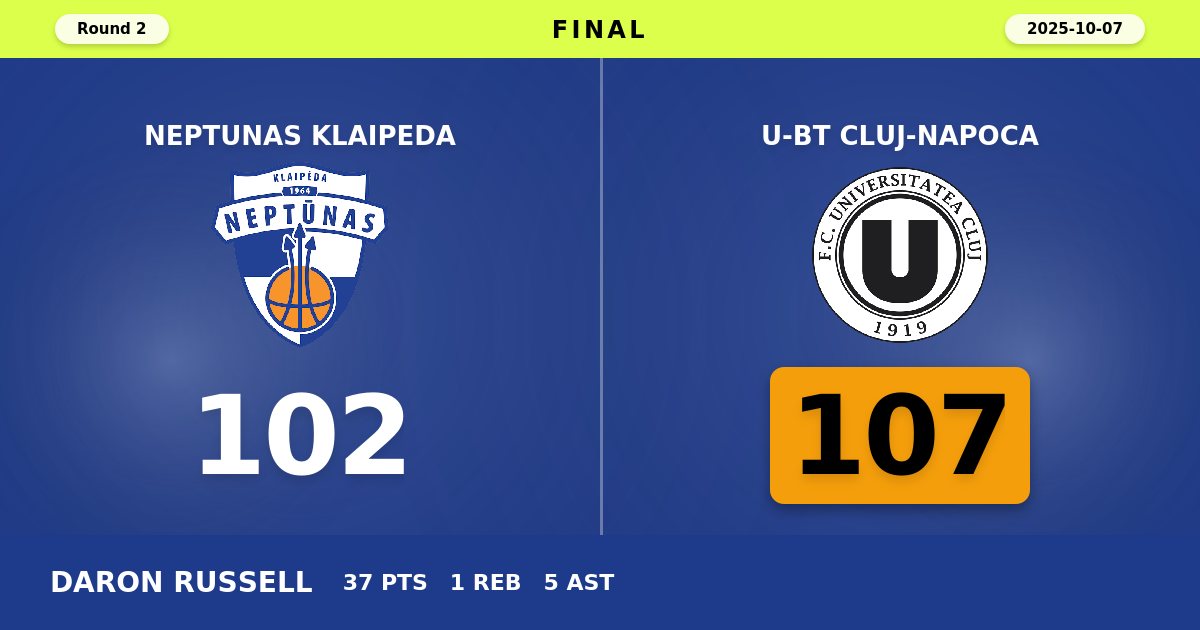
U-BT Cluj-Napoca bounced back from their opening-round defeat in emphatic fashion, overcoming Neptunas Klaipeda 107-102 in a thrilling Round 2 encounter at Klaipėda. The Romanian side, still smarting from their 90-98 home loss to Bahcesehir College Istanbul, found their savior in substitute guard Daron Russell, who delivered a virtuoso 37-point performance that will be remembered as one of the standout individual displays of the early EuroCup season.
Before a crowd of 2,087 at the Svyturio Arena, Cluj demonstrated the resilience and offensive firepower that will serve them well throughout this campaign. After trailing 28-19 at the end of the first quarter, the visitors steadily chipped away at the deficit, matching Neptunas 29-28 in the second period to head into halftime down just seven points. The momentum continued to shift after the break, as Cluj dominated the third quarter 29-22 and eventually sealed the victory with a 30-24 advantage in the final period.
Russell's Record-Breaking Night
Coming off the bench, Daron Russell was nothing short of sensational. The American guard played nearly 33 minutes and was virtually unstoppable, converting 11 of his 23 field goal attempts, including an impressive 7-of-13 from beyond the arc. His ability to get to the free-throw line proved crucial, as he sank 8 of 9 attempts from the charity stripe while drawing 14 fouls from the frustrated Neptunas defense.
Russell's efficiency rating of 38 told the story of a complete offensive performance. Beyond his scoring, he contributed five assists and two steals, demonstrating the all-around game that makes him such a dangerous weapon. His plus-minus of +6 reflected his impact on winning basketball, as Cluj consistently performed better when he was on the floor. The 180-centimeter guard's ability to create his own shot and make plays for others kept Neptunas off balance throughout the contest.
Supporting Cast Delivers for Cluj
While Russell grabbed the headlines, U-BT Cluj-Napoca received significant contributions from across their roster. Australian forward Mitchell Creek was highly efficient, scoring 20 points on 8-of-13 shooting from the field. Creek did his damage primarily in the paint, converting 8 of 10 two-point attempts while adding four rebounds, two assists, and two steals in over 32 minutes of action. His plus-minus of +10 was the best on the team, indicating his presence was vital to Cluj's success.
Inside the paint, Nathan Mensah provided the physical presence Cluj needed. The Ghanaian center recorded a double-double with 15 points and 13 rebounds, including six offensive boards that gave his team crucial second-chance opportunities. Mensah also protected the rim with two blocks and altered numerous other attempts, finishing with an efficiency rating of 26. His 6-of-10 shooting from the field demonstrated improved touch around the basket.
Karel Guzman, the Cuban point guard, orchestrated the offense effectively with 13 points, five rebounds, four assists, and three steals. His defensive pressure helped force turnovers at critical moments, though his 4-of-12 shooting suggested room for improvement. Veteran Serbian big man Dusan Miletic provided quality minutes off the bench, contributing seven points, six rebounds, two assists, two steals, and a block in just under 22 minutes. Romanian forward Patrick Richard added six points on a perfect 2-of-3 shooting from three-point range.
Neptunas Falls Short Despite Balanced Attack
Neptunas Klaipeda came into this contest looking to build on momentum, having lost their opening game 85-95 away to Idea Slask. The Lithuanian side showed flashes of the team that could compete in this competition but ultimately couldn't sustain their strong start through four quarters.
Donatas Tarolis led the home side with an excellent all-around performance, registering 21 points, five rebounds, and five assists. The Lithuanian forward was highly efficient, shooting 8-of-11 from the field, including 3-of-4 from three-point range. His efficiency rating of 28 matched the quality of his play, but Neptunas needed more help to overcome Cluj's balanced attack.
Arnas Velicka came close to matching Tarolis's output, finishing with 19 points, four rebounds, and seven assists in nearly 29 minutes. Velicka was perfect inside the arc, making all four of his two-point attempts, and added three three-pointers. However, his five turnovers represented possessions that Neptunas couldn't afford to waste in such a close contest.
Bench Production Proves Decisive
The difference in this game ultimately came down to bench production, where Cluj held a significant advantage. While Russell's 37 points led the way, substitutes Dusan Miletic and Patrick Richard combined for 13 additional points, giving Cluj crucial scoring punch in reserve.
For Neptunas, the bench struggled to provide consistent offense. Jordan Tucker managed just six points on 2-of-6 shooting, while Zane Waterman contributed seven points but posted a negative efficiency rating of -3. Harrison Cleary provided a spark with 10 points in limited minutes, but it wasn't enough to offset Cluj's deeper rotation.
Mindaugas Girdziunas hit three three-pointers for nine points but struggled with turnovers, committing three in just over 19 minutes. His plus-minus of -10 was the worst on the team, suggesting Neptunas leaked points whenever he was on the court. James Karnik grabbed six rebounds and scored six points in 16 minutes, showing energy but lacking the scoring punch Neptunas needed from their reserves.
Key Statistical Advantages
Several statistical categories revealed why U-BT Cluj-Napoca emerged victorious. The visitors shot 47.5% from the field compared to Neptunas's 44.4%, a small but significant margin over 40 minutes. More importantly, Cluj converted 12 of 31 three-point attempts (38.7%), while Neptunas made 11 of 37 from beyond the arc (29.7%).
Free throws played a crucial role, with Cluj attempting 39 compared to Neptunas's 21. Russell alone took 9 free throws, exploiting the Lithuanian side's foul trouble. Cluj converted 27 of their 39 attempts (69.2%), a percentage that left points on the table but still provided a significant advantage in total free-throw points.
The rebounding battle was relatively even, with both teams securing over 30 boards, but Cluj's 13 offensive rebounds from Nathan Mensah alone created extra possessions at crucial moments. Assists were nearly identical, with both teams distributing the ball well, but Cluj's ability to force turnovers and convert them into points proved decisive down the stretch.
Implications Moving Forward
For U-BT Cluj-Napoca, this road victory represents exactly the kind of response head coach needed after the disappointing home loss to Bahcesehir. The team showed character in battling back from a nine-point first-quarter deficit and demonstrated the offensive versatility that makes them dangerous. With Daron Russell proving he can carry the scoring load when needed and Mitchell Creek providing consistent two-way excellence, Cluj has multiple offensive weapons to deploy.
The integration of Nathan Mensah is clearly progressing well, as his double-double performance showed the impact he can have on both ends of the floor. If Cluj can maintain this level of bench production and continue to share the ball effectively, they have the potential to be a difficult matchup for any team in the competition.
Neptunas Klaipeda now sits at 0-2 and must quickly regroup to avoid falling further behind in the standings. The Lithuanian side showed they can compete, building that early lead and receiving strong performances from Donatas Tarolis and Arnas Velicka. However, the inability to maintain defensive intensity for 40 minutes and the lack of consistent bench scoring are concerns that must be addressed.
The officiating crew of Steve Bittner, Thomas Bissuel, and Vasiliki Tsaroucha called a tight game, with 53 total fouls whistled. This physical contest tested both teams' depth, and Cluj's ability to navigate foul trouble better proved advantageous. As the EuroCup season continues, both teams will need to adjust to the physicality and rhythm of European competition, where every possession and defensive stop can determine the outcome.