Maccabi's Surge Continues with Dominant Road Performance
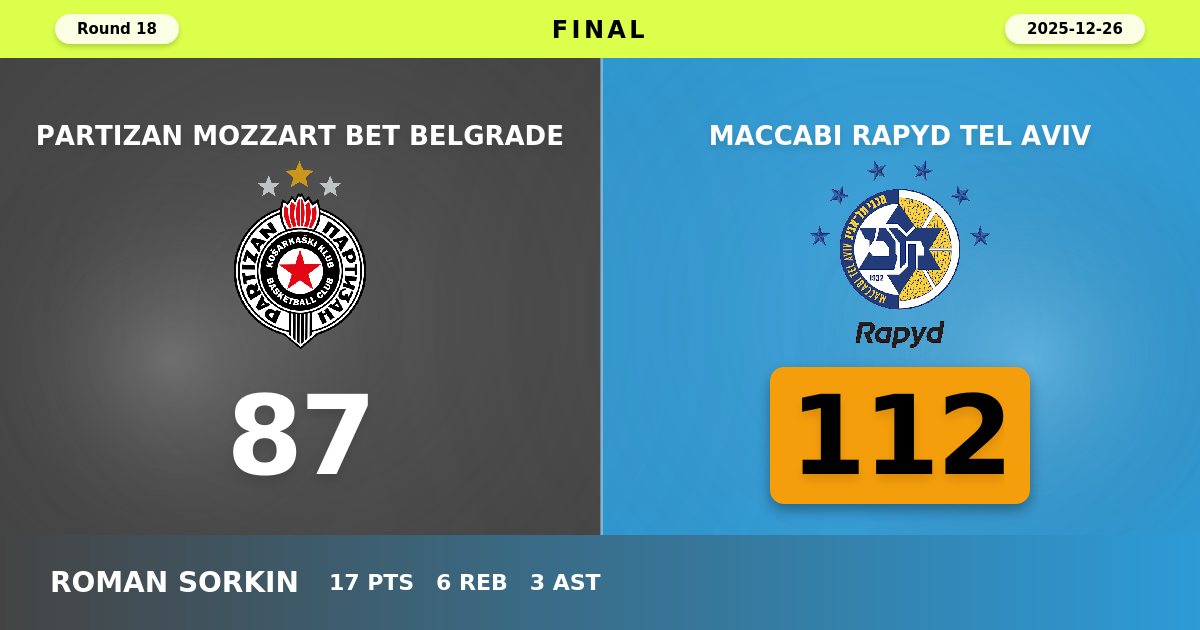
Maccabi Rapyd Tel Aviv delivered a statement performance on the road, crushing Partizan Mozzart Bet Belgrade 112-87 in front of 13,749 fans at Partizan's home arena. The victory marked Maccabi's fifth consecutive win and showcased their growing momentum in the EuroLeague campaign, while Partizan's struggles continued with another disappointing home defeat.
The Israeli powerhouse completely overwhelmed their Serbian hosts, particularly in a devastating second and third quarter stretch that transformed a competitive opening period into a one-sided affair. Maccabi's balanced attack, featuring seven players scoring in double figures, proved too much for a Partizan side still searching for consistency after a string of difficult results.
First Quarter: A Deceptively Close Start
The opening quarter suggested a competitive affair as both teams traded baskets in an entertaining start. Partizan edged the period 31-30, with Sterling Brown showing early aggression and Cameron Payne contributing from beyond the arc for the home side. However, this narrow margin would prove misleading as Maccabi was merely warming up.
Lonnie Walker IV immediately announced his presence for the visitors, displaying the scoring prowess that would define his evening. Roman Sorkin also made his mark early, efficiently converting inside opportunities that would become a recurring theme throughout the contest.
The Turning Point: Second Quarter Devastation
The second quarter witnessed Maccabi Rapyd Tel Aviv completely take control of the contest. The visitors outscored Partizan 28-12 in a dominant ten-minute stretch that effectively decided the outcome. Maccabi's defensive intensity suffocated the home team's offensive rhythm, while their transition game proved unstoppable.
Partizan's offense ground to a halt, managing just 12 points in the quarter—a catastrophic collapse that left them trailing 58-43 at halftime. Vanja Marinkovic and his teammates struggled to generate quality looks against Maccabi's swarming defense, and the home crowd's early enthusiasm began to dissipate as the deficit grew.
The Israeli squad's ball movement was exceptional during this period, with Jimmy Clark III orchestrating the offense brilliantly and finding open shooters consistently. The depth of Maccabi's roster became evident as contributions came from multiple sources, preventing Partizan from focusing their defensive efforts on any single player.
Third Quarter: Maccabi Extends Their Dominance
Any hopes of a Partizan comeback were extinguished in the third quarter as Maccabi poured in 34 points while holding the hosts to just 16. The 58-43 halftime lead ballooned to 92-59, turning the final quarter into mere formality. Lonnie Walker IV was particularly devastating during this stretch, knocking down contested three-pointers and attacking the rim with confidence.
Roman Sorkin continued his efficient scoring inside, finishing 6-of-7 from two-point range for the quarter and the game. His ability to establish position and convert at the rim gave Maccabi a reliable interior presence that Partizan simply couldn't match. Bruno Fernando and Tyrique Jones tried to provide resistance for the home team, but they were overwhelmed by Maccabi's collective effort.
The defensive performance from the visitors was equally impressive, with Iffe Lundberg and Tamir Blatt providing energetic perimeter defense off the bench. Their ability to pressure the ball and disrupt passing lanes created numerous transition opportunities that Maccabi converted with ruthless efficiency.
Individual Brilliance: Walker and Sorkin Lead the Charge
Lonnie Walker IV produced a masterful performance, leading all scorers with 20 points on 7-of-14 shooting, including an impressive 5-of-11 from three-point range. His efficiency rating of 24 reflected his all-around contribution, which also included five assists, three steals, and a block. Walker's plus-minus of +25 told the story of Maccabi's dominance when he was on the floor.
Roman Sorkin was nearly perfect from the field, converting 7-of-8 attempts for 17 points. The Israeli big man added six rebounds and three assists, showcasing improved playmaking from the post. His efficiency rating of 26 was the game's highest, and his ability to finish through contact while drawing fouls proved crucial in establishing Maccabi's interior dominance.
The bench contributions were vital to Maccabi's success. TJ Leaf provided instant offense with 14 points on a remarkable 7-of-8 shooting, while Tamir Blatt orchestrated the second unit beautifully with seven assists. Marcio Santos added 10 points and displayed his versatility, contributing on both ends of the floor with a plus-15 rating in his 17 minutes.
Partizan's Struggles Continue
For Partizan Mozzart Bet Belgrade, this defeat represented another chapter in a difficult stretch that has seen them lose four of their last five games. Cameron Payne did his best to keep Partizan competitive, finishing with 15 points and six assists, but his efforts were insufficient against Maccabi's collective excellence.
Sterling Brown added 12 points, connecting on 3-of-6 from deep, while Tyrique Jones provided solid work off the bench with 10 points on 5-of-6 shooting. However, these individual performances were overshadowed by Partizan's overall offensive struggles and defensive breakdowns.
The home team's shooting percentages told a grim story. While Maccabi shot efficiently throughout, Partizan struggled to find rhythm, particularly from beyond the arc. Duane Washington endured a difficult evening, finishing just 3-of-13 from the field with three turnovers, exemplifying Partizan's offensive challenges.
Isaac Bonga provided some energy off the bench with 10 points and drew six free throws, but his minus-19 rating reflected the team's struggles when he was on the court. The inability to slow down Maccabi's transition game and contain their multiple scoring threats proved decisive.
Tactical Analysis: Maccabi's System Prevails
Maccabi's coaching staff deserves immense credit for preparing a game plan that exploited Partizan's defensive vulnerabilities. The decision to push tempo consistently forced Partizan into uncomfortable situations, and the ball movement created numerous open looks that the visitors converted efficiently.
The depth rotation proved crucial, with Maccabi utilizing 14 players effectively. John Dibartolomeo, William Rayman, and Gur Lavi all contributed meaningful minutes, maintaining defensive intensity and offensive flow when starters rested.
Defensively, Maccabi's switching schemes confused Partizan's offense, particularly in the crucial second quarter. The aggressive help defense prevented easy rim attempts while the active hands in passing lanes generated steals and deflections that fueled the transition attack.
Implications and Looking Ahead
This victory improves Maccabi's standing significantly as they continue their impressive winning streak. With five consecutive victories, they've positioned themselves as genuine contenders in the EuroLeague, demonstrating the balance and depth necessary for sustained success. The team's ability to dominate on the road, especially in a hostile environment like Belgrade, showcases their mental toughness and collective quality.
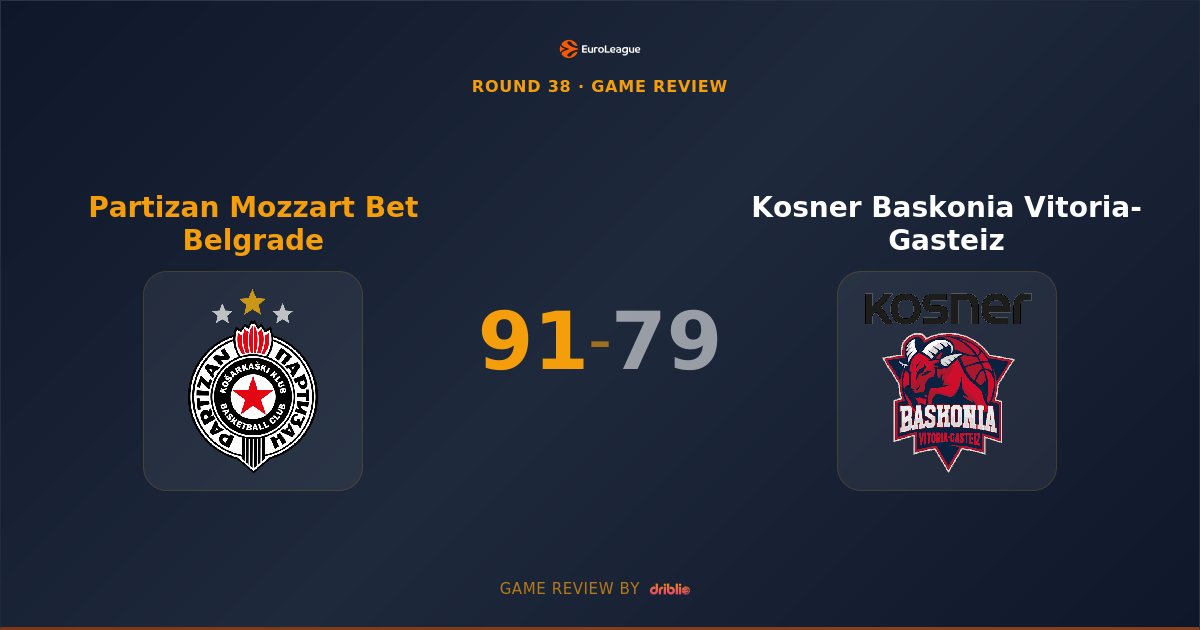
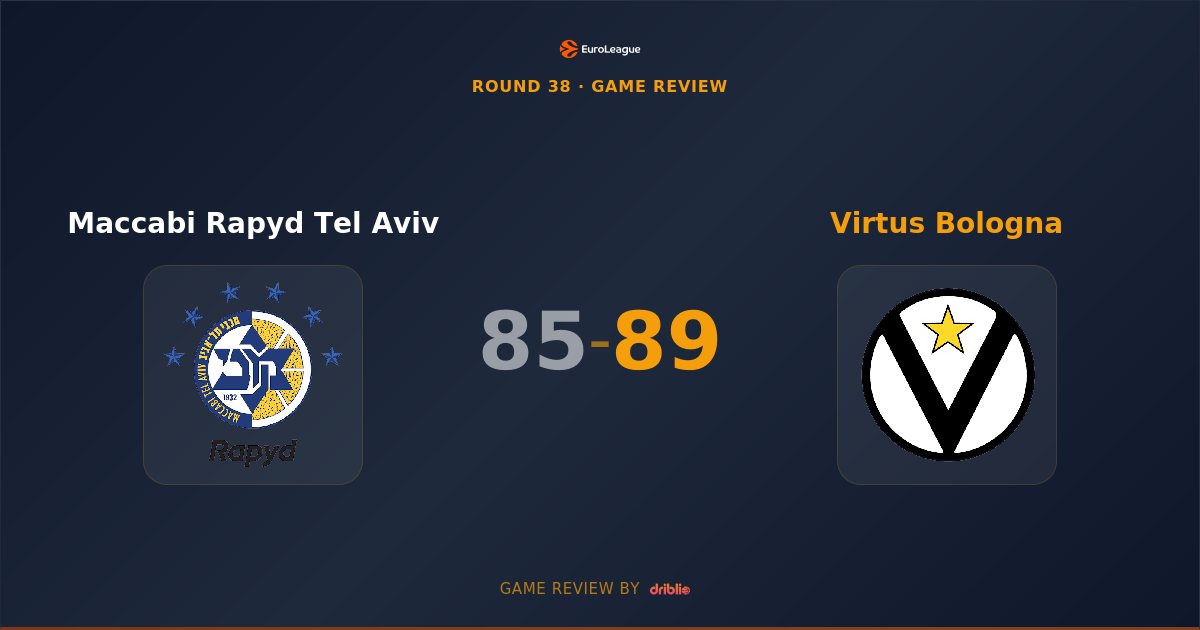
For Partizan, the challenges mount as they search for answers to stop their slide. The home loss drops them further in the standings and raises questions about their ability to compete with the league's elite teams. The coaching staff must address the defensive breakdowns and offensive inconsistency that have plagued recent performances. With previous losses to Zalgiris Kaunas and Virtus Bologna still fresh, finding solutions becomes increasingly urgent.
The 25-point margin of victory represents Maccabi's largest road win of the season and sends a clear message to the rest of the EuroLeague. When their offense flows as smoothly as it did in Belgrade, with multiple scoring threats and efficient shot selection, they possess the firepower to challenge any opponent. The chemistry between starters and bench players appears seamless, creating matchup problems that few teams can solve.