Fourth Quarter Surge Secures Victory for Wroclaw
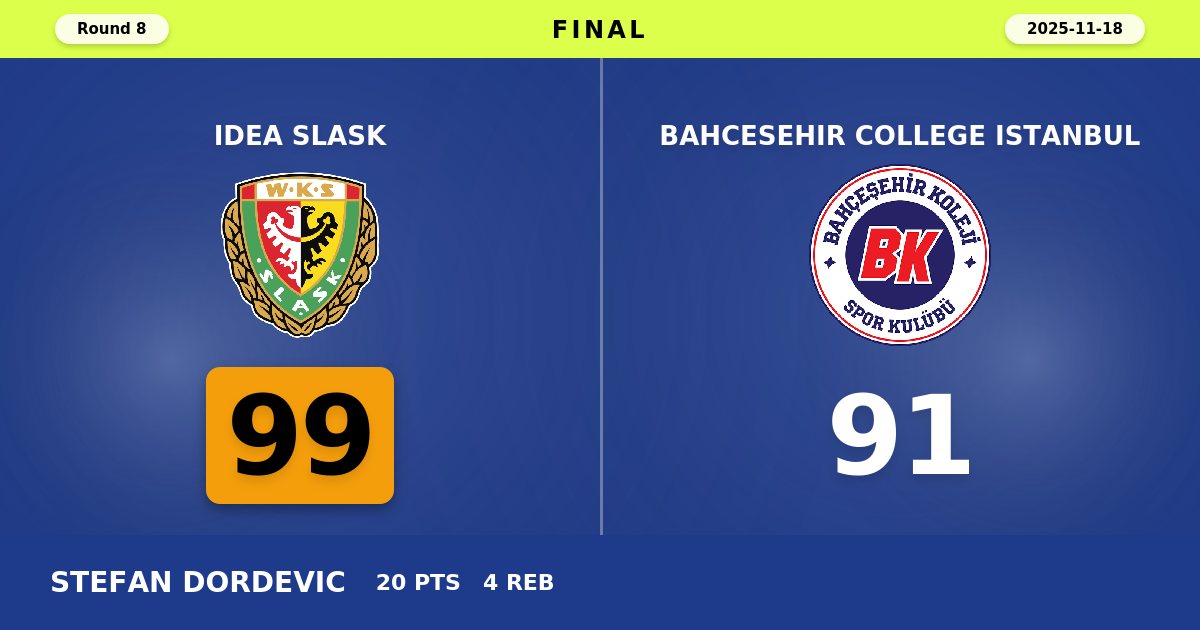
Idea Slask Wroclaw delivered a commanding performance in front of 2,507 home fans, overcoming a difficult start to defeat Bahcesehir College Istanbul 99-91 in Round 8 of EuroCup action. The Polish side demonstrated remarkable resilience, erasing a ten-point first-quarter deficit with a spectacular 35-point fourth quarter that sealed their second consecutive victory.
The game began ominously for the home side as Bahcesehir stormed out to a 30-20 advantage after the opening frame. The Turkish squad appeared poised to continue their impressive form, having won six of their last seven games coming into this matchup. However, Wroclaw's halftime adjustments and increased defensive intensity would prove decisive as the match progressed.
Kirkwood and Dordevic Lead the Charge
Noah Kirkwood emerged as the catalyst for Wroclaw's triumph, finishing with 21 points on an efficient 7-of-11 shooting, including a remarkable 5-of-7 performance from beyond the arc. The Canadian forward also contributed six assists and maintained a game-high plus-minus rating of +24, showcasing his impact on both ends of the floor. His ability to stretch the defense with his perimeter shooting created crucial spacing that allowed his teammates to operate effectively in the paint.
Stefan Dordevic complemented Kirkwood's performance with 20 points of his own, dominating the interior with an impressive 8-of-14 shooting from two-point range. The Serbian big man's physical presence and efficient scoring proved vital during key stretches, particularly in the second half when Wroclaw began to assert their dominance. His four free throws made without a miss demonstrated his composure under pressure.
Kadre Gray added 16 points despite struggling with seven turnovers, while Ajdin Penava provided an important spark off the bench with 13 points on a highly efficient 5-of-7 shooting performance, including 2-of-2 from three-point range. The balanced scoring attack reflected Wroclaw's depth and their ability to generate offense from multiple sources throughout the contest.
Bahcesehir's Offensive Limitations
Despite the loss, Caleb Homesley delivered a gritty performance for Bahcesehir, leading all scorers with 20 points. His perfect 13-of-13 showing from the free-throw line kept the visitors within striking distance throughout much of the contest. However, his struggles from the field, converting just 3-of-10 attempts including 1-of-6 from three-point range, highlighted Wroclaw's defensive adjustments in containing the American guard.
Malachi Flynn contributed 13 points but endured a difficult shooting night, particularly from long range where he managed just 1-of-10. His five turnovers and minus-10 rating illustrated the pressure that Wroclaw's defense applied to Bahcesehir's primary ball-handlers. The former NBA guard's inability to find his rhythm from deep proved costly as the game reached its critical moments.
Trevion Williams provided solid interior play with 12 points and six rebounds on 5-of-7 shooting, while Mateusz Ponitka added 11 points. However, the collective offensive efficiency of the starting unit wasn't sufficient to counter Wroclaw's second-half surge. Ponitka's five personal fouls limited his impact during crucial stretches, forcing him to play more cautiously on the defensive end.
Bench Production Makes the Difference
The contrasting bench performances ultimately tilted the contest in Wroclaw's favor. While Ajdin Penava, Angel Nunez, and Blazej Kulikowski combined for 24 points with solid efficiency for the home side, Bahcesehir's reserves struggled to match that production. Matthew Mitchell led the Turkish bench with 10 points, but the overall contribution wasn't enough to maintain their early advantage.
Kenan Sipahi provided quality minutes with seven points and four assists in over 21 minutes of action, while Balsa Koprivica added six points and six rebounds. Despite their individual efforts, Bahcesehir's second unit couldn't generate the consistent scoring necessary to keep pace with Wroclaw's increasingly potent offense as the game wore on.
Tactical Adjustments Fuel Comeback
Wroclaw's coaching staff deserves significant credit for their halftime adjustments. After trailing by ten points following the first quarter, the home side tightened their defensive rotations and began attacking the paint with greater purpose. The 24-17 advantage in the second quarter provided momentum, and while the third period was evenly contested at 20-20, Wroclaw set the stage for their fourth-quarter explosion.
The final frame showcased everything that makes Wroclaw dangerous at home. Their 35-point eruption overwhelmed Bahcesehir's 24-point output, with multiple players stepping up in crucial moments. The ball movement improved dramatically, as evidenced by Jakub Niziol's eight assists, which helped generate quality looks throughout the lineup.
Defensively, Wroclaw's increased pressure on Bahcesehir's perimeter players forced uncomfortable shots and disrupted the rhythm that had served the visitors so well in the opening quarter. The home side's ability to contest three-point attempts without fouling proved particularly effective, as Bahcesehir managed just 5-of-28 shooting from beyond the arc after their hot start.
Implications for Both Teams
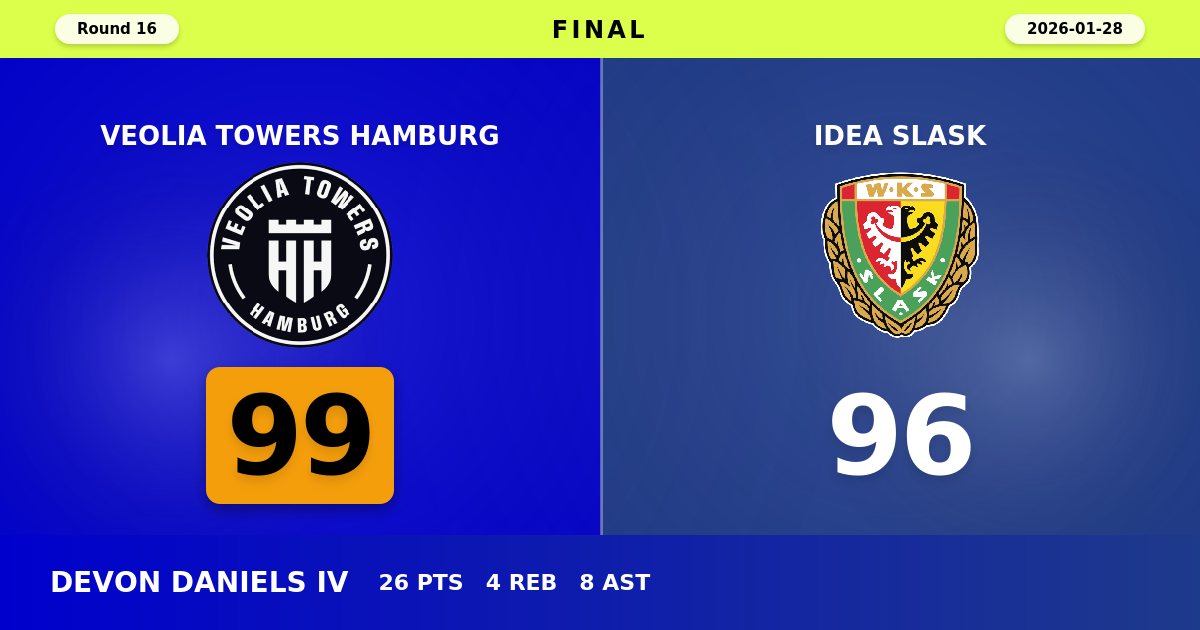
This victory represents a crucial confidence boost for Idea Slask Wroclaw, who had endured a challenging stretch earlier in the season. Following losses to Aris TT Bank, Umana Reyer Venice, Hapoel Jerusalem, and BAXI Manresa, the team appears to have found their identity. Back-to-back victories against Veolia Towers Hamburg and now Bahcesehir suggest that the Polish club is beginning to gel at the right time.
The home-court advantage at Wroclaw is proving valuable, as the team continues to feed off the energy of their passionate supporters. With improved chemistry and multiple scoring options, they're positioned to make noise in the EuroCup competition moving forward. The balanced attack and improved fourth-quarter execution should serve as a template for future success.
For Bahcesehir College Istanbul, this setback interrupts an otherwise impressive run of form. Despite the loss, their recent body of work—including victories over Aris TT Bank, BAXI Manresa, Union Olimpija Ljubljana, Veolia Towers Hamburg, Umana Reyer Venice, and U-BT Cluj-Napoca—demonstrates their quality and competitiveness. However, their inability to maintain their first-quarter intensity for forty minutes will require attention.
The Turkish side's reliance on perimeter shooting proved problematic when shots weren't falling, as their 5-of-28 three-point shooting illustrated. Developing more consistent interior scoring options beyond Williams and finding ways to generate easier baskets will be priorities as they prepare for upcoming challenges. Their 7-4 record in recent outings suggests the talent is present; execution in critical moments needs refinement.
Statistical Story Tells Complete Picture
The statistical breakdown reveals the nature of Wroclaw's victory. While Bahcesehir actually attempted more field goals overall, their efficiency from three-point range proved disastrous. The home side's superior free-throw attempts (31 versus 30) and conversion rate kept them in control during the final period. Wroclaw's ability to get to the line and convert at crucial moments demonstrated their aggressiveness and poise.
Rebounding was relatively even, though Wroclaw's offensive boards provided valuable second-chance opportunities. The turnover battle slightly favored the visitors, but Wroclaw's ability to convert those possessions into points made the difference. The plus-minus statistics clearly illustrate which players impacted winning: Kirkwood's +24, Dordevic's +8, and Nunez's +2 off the bench contrasted sharply with Ponitka's -19, Homesley's -14, and Gray's -13 for Bahcesehir.
As both teams continue their EuroCup campaigns, this Round 8 encounter will be remembered as a showcase of resilience from Wroclaw and a learning experience for Bahcesehir. The Polish side proved that they possess the firepower and mental fortitude to overcome early deficits, while the Turkish club discovered that maintaining intensity for the entire forty minutes is essential at this level of competition.