Hapoel Tel Aviv Delivers Statement Win Over Struggling Fenerbahce
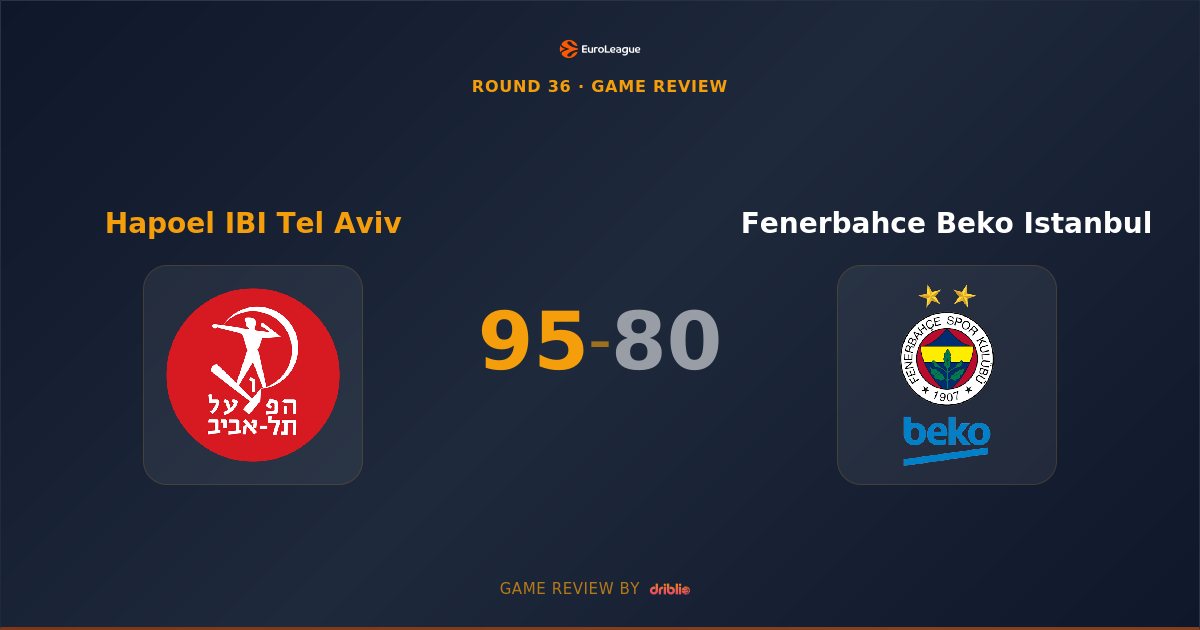
Hapoel IBI Tel Aviv produced a comprehensive performance at ARENA 8888 SOFIA, defeating Fenerbahce Beko Istanbul 95-80 in Round 36 of the EuroLeague regular season. The Israeli side controlled proceedings from start to finish, building a substantial lead through three quarters before comfortably managing the final period to secure a vital victory that continues their push for playoff positioning.
The home team's dominance was evident from the opening tip, as they raced to a 25-17 advantage after the first quarter and never looked back. Elijah Bryant set the tone early with aggressive drives to the basket, while Vasilije Micic orchestrated the offense with his characteristic poise and precision. The Serbian guard's ability to penetrate and create scoring opportunities kept the Turkish visitors constantly off-balance throughout the contest.
Second Quarter Surge Establishes Control
The second period saw Hapoel Tel Aviv extend their advantage to 51-38 by halftime, building a cushion that would prove insurmountable. The home side's offensive rhythm was exemplary, moving the ball with purpose and finding open looks consistently. Bryant continued his excellent work, finishing the half with strong numbers while drawing fouls and getting to the free-throw line with regularity.
Fenerbahce Beko Istanbul struggled to find any consistent offensive flow, with Wade Baldwin IV working hard to create opportunities but receiving insufficient support from his teammates. The visitors' shooting percentages remained below acceptable standards, and their inability to protect the defensive glass allowed Hapoel multiple second-chance opportunities that proved costly.
The halftime statistics told a clear story of Hapoel's superiority. They dominated the paint, controlled the tempo, and executed their offensive sets with far greater efficiency than their opponents. Micic was particularly effective from the free-throw line, converting eight of nine attempts in the first half alone, demonstrating the kind of clutch shooting that has made him one of Europe's premier guards.
Third Quarter Dominance Seals the Outcome
Any hopes of a Fenerbahce comeback were extinguished in the third quarter as Hapoel continued to pour on the pressure. The home team's defense tightened considerably, forcing turnovers and converting them into easy transition baskets. Dan Oturu emerged as a dominant interior presence during this period, using his size and athleticism to control the paint at both ends of the floor.
The American center was virtually unstoppable around the rim, finishing with an impressive nine-of-eleven shooting performance that yielded 23 points. His efficiency was remarkable, and when combined with his shot-blocking ability and defensive rebounding, Oturu provided exactly the kind of interior presence that Hapoel needed to maintain their comfortable advantage.
Fenerbahce's frustrations mounted as the quarter progressed. Talen Horton Tucker struggled mightily from the field, managing just two made baskets on nine attempts. The Turkish side's perimeter shooting remained cold, and their inability to stretch Hapoel's defense allowed the home team to pack the paint and challenge every shot attempt near the basket.
By the end of the third quarter, Hapoel had extended their lead to 75-56, effectively putting the game beyond reach. The 19-point advantage reflected their superiority in nearly every statistical category, from field goal percentage to assists to defensive rebounds. Antonio Blakeney provided valuable energy off the bench, contributing timely baskets and helping to maintain the offensive momentum whenever the starters rested.
Fourth Quarter Management Closes Out Victory
The final period became an exercise in game management for Hapoel Tel Aviv. With the outcome no longer in serious doubt, both teams made numerous substitutions, giving valuable minutes to reserves and allowing key players to conserve energy. Nevertheless, Hapoel maintained their professionalism, never allowing Fenerbahce to mount any semblance of a meaningful rally.
Chris Jones orchestrated the offense effectively in the fourth quarter, finishing with seven assists for the game and demonstrating excellent court vision. His three-pointer early in the period exemplified the confidence flowing through the Hapoel roster, as they continued to play with freedom and creativity despite the comfortable margin.
For Fenerbahce, Wade Baldwin IV finished as the team's leading scorer with 22 points, but his efforts came largely in isolation without the collective support needed to challenge a well-organized opponent. Tarik Biberovic provided occasional spark with his three-point shooting, converting three of five attempts from beyond the arc, but the Turkish side's overall offensive execution remained disjointed throughout.
Statistical Dominance Reflects on-Court Superiority
The final numbers painted a clear picture of Hapoel's comprehensive victory. Elijah Bryant led all scorers with 21 points on efficient eight-of-sixteen shooting, while also contributing nine rebounds and five assists in an outstanding all-around performance. His efficiency rating of 32 was the highest of any player on the court, reflecting his immense impact on the game's outcome.
Dan Oturu finished with a double-digit scoring effort that included 23 points on remarkable nine-of-eleven shooting from the field. The center also added three blocks and proved to be a constant problem for Fenerbahce's interior defenders. His plus-minus of zero reflected the time he spent on the court during various game situations, but his impact when it mattered most was undeniable.
Vasilije Micic contributed 19 points and orchestrated the offense with his usual intelligence, though he finished with three turnovers that slightly marred an otherwise excellent performance. His eight-of-nine free throw shooting demonstrated his composure under pressure and his ability to draw fouls when attacking the basket.
For the visitors, Devon Hall added 11 points and four assists, working tirelessly to create opportunities in a losing effort. Tarik Biberovic matched that total with his 11 points, but Fenerbahce's supporting cast failed to provide adequate production, leaving too much responsibility on the shoulders of their primary creators.
Tactical Analysis and Key Factors
Hapoel Tel Aviv's victory was built on several fundamental pillars that Fenerbahce simply could not counter. The home team's interior dominance was paramount, with Oturu and Bryant repeatedly attacking the rim and either finishing strongly or drawing fouls. This inside-out approach opened opportunities for perimeter shooters and created the spacing necessary for their offensive system to function smoothly.
Defensively, Hapoel executed their game plan with discipline and intensity. They contested shots without fouling excessively, controlled the defensive glass to limit second-chance opportunities, and forced Fenerbahce into difficult, contested attempts throughout the game. The visitors' field goal percentage reflected this defensive pressure, as they struggled to find clean looks against Hapoel's well-organized schemes.
Fenerbahce's struggles can be attributed to several factors, including their inconsistent perimeter shooting and inability to establish any rhythm offensively. Talen Horton Tucker's difficult night exemplified the team's broader challenges, as he finished with just 10 points on four-of-sixteen shooting, including a disappointing two-of-seven performance from three-point range.
Implications and Looking Forward
This victory represents an important statement from Hapoel Tel Aviv as they continue their campaign in one of Europe's most competitive basketball leagues. The comprehensive nature of the win, combined with contributions from multiple players, suggests a team finding its best form at a crucial stage of the season. Their recent record shows resilience and quality, with victories over strong opponents demonstrating their capability to compete at the highest level.
For Fenerbahce Beko Istanbul, this defeat extends a troubling recent run of form that has seen them lose four consecutive games. The Turkish giants will need to regroup quickly and address the offensive inconsistencies and defensive vulnerabilities that have plagued them during this difficult stretch. With talent throughout their roster, the potential for improvement exists, but translating that potential into consistent performances remains an ongoing challenge.
The 95-80 final score accurately reflected the gap between the two teams on this particular evening, with Hapoel Tel Aviv earning every bit of their 15-point victory margin through superior execution, intensity, and collective effort across all four quarters of play.